When should a collector restore an antique billiard table instead of commissioning new?
Antique tables carry history, but not every one deserves a costly restoration. Here is how to weigh reviving a period piece against ordering a new heirloom built to your room and your game.
Start with the bones, not the beauty
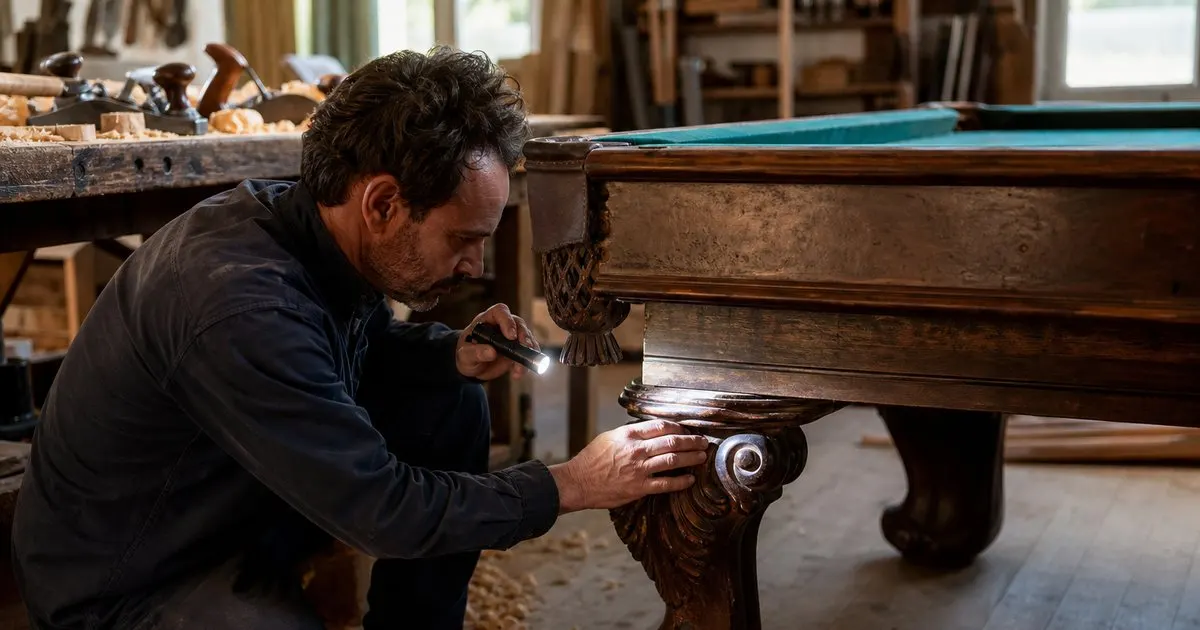
The restore-or-replace decision is settled by structure long before it is settled by taste. A period table from the late nineteenth or early twentieth century typically rests on a hardwood frame with heavy cross members, and the slate sits on top of that frame in two or three pieces. Before anything else, get underneath it. Look for loose mortise and tenon joints, cross members that have sagged or split along the grain, and earlier repairs made with modern screws, angle brackets, or construction adhesive. Any of those tells you someone has already fought this table and may have lost. Related: What slate thickness truly matters when buying a premium billiard table for home?
Then inspect the slate itself, because slate is the one component that cannot be conjured back. Cracks running from the pocket cutouts, chips along the seams, and old plaster or wax filler that has been ground into a valley are all warning signs. A slate that has been broken and pinned back together will never hold a true level for long. Cosmetic problems, by contrast, are usually the most alarming to look at and the cheapest to fix. Lifting veneer, a cloudy or alligatored finish, and missing inlay are the everyday work of a competent conservator.
Keep reading: How do you select an heirloom pool table that lasts for several generations?, What slate thickness truly matters when buying a premium billiard table for home?, Which hardwoods age most gracefully in a fine heirloom quality billiard table?. See how Billiardr helps you a craftsman guide to heirloom pool and billiard tables.
What a proper restoration actually involves
A genuine restoration is a full disassembly, not a refinish. The rails come off and the cushion rubber, which hardens and loses rebound over decades, is replaced and the rails refaced. Pockets are releathered or their irons cleaned and rebuilt. The slate is lifted, cleaned of old filler, checked for flatness, and reseamed. The frame is reglued where joints have opened, and the finish is either conserved or stripped and rebuilt depending on how much of the original survives. On a heavily carved table with extensive veneer and inlay, the labor in that list can approach the cost of a new mid-range heirloom table. Related: How do you select an heirloom pool table that lasts for several generations?
Expect the timeline to be measured in months rather than weeks. Specialists who do this work well are few, and the table typically has to travel to their shop and back, which adds crating, transport, and risk at each end. There is also the matter of materials. Some period tables carry ivory sights or inlay, and the sale and movement of ivory is regulated at the federal level and by a number of states, so missing pieces are often replaced with shell, bone, or resin rather than like-for-like. A good restorer will tell you this up front rather than promise a perfect match.
When commissioning new is the wiser path
New makes more sense when the antique simply does not fit the life you intend for it. Many surviving period tables are nine or even ten feet long, built for halls and clubs rather than a modern game room, and a table that crowds the room will never be played with pleasure. If you want a dining conversion, a specific hardwood, modern cushion profiles that play consistently, or a playing size matched to your space, a commissioned table delivers all of that with a written warranty and a defined lead time instead of a series of discoveries. Related: Which hardwoods age most gracefully in a fine heirloom quality billiard table?
There is also an honest distinction between sentimental value and market value. A table that came down through your own family is worth restoring even when the arithmetic is unkind, because what you are preserving is not a commodity. An anonymous antique found at an estate sale should be judged on the numbers alone. Remember too that a well-built new table from a small shop is itself a future antique. In fifty years, the maker's mark on a table you commissioned today will mean as much to your grandchildren as a period name does to you now.
A practical framework for deciding
Score the candidate on three axes: structural integrity, significance, and fit. Structural integrity is the frame and slate assessment above. Significance covers the maker, the rarity of the model, and any documented history. Fit means the room, the game you play, and how the table will be used. Before you commit to an antique, pay a restorer for a written assessment with an itemized scope of work, then set that beside a written quote for a comparable new table from a maker you trust. Comparing two real documents beats comparing hope against a brochure. Related: Why does room size dictate the ideal billiard table dimensions for comfortable play?
If you do restore, favor conservation over transformation. Keep the original finish wherever it is sound, replace only the components that affect play, and resist the urge to make a hundred-year-old table look like it left the factory yesterday. Collectors typically prize originality, and an over-restored antique can be worth less than a carefully conserved one with honest wear. Photograph everything before, during, and after, and keep the restorer's invoice with the table. That record becomes part of the provenance and part of the value.
- Judge an antique by its frame and slate first; cosmetic flaws are the easy part.
- A real restoration means full disassembly, new cushion rubber, reseamed slate, and months of specialist work.
- Commission new when the antique does not fit your room, your game, or your need for a warranty.
- Conserve rather than over-restore, and document every step to protect the table's value.

Julien Jimenez
Julien Jimenez is an independent software builder based in Paris. He designs, ships, and operates focused SaaS products for small businesses and independent professionals. Read the full author page.
A Table Built to Be Inherited
A craftsman guide to heirloom pool and billiard tables. Billiardr is built to help you put this into practice.
Find your tableMore from the Billiardr blog
How do you select an heirloom pool table that lasts for several generations?
What slate thickness truly matters when buying a premium billiard table for home?
Which hardwoods age most gracefully in a fine heirloom quality billiard table?
Get the complete heirloom pool and billiard tables guide
Our full buying guide, the price guide, and new research as we publish it. One email, no spam, unsubscribe any time.